Showing posts with label Battle accounts. Show all posts

Tuesday, January 11, 2011

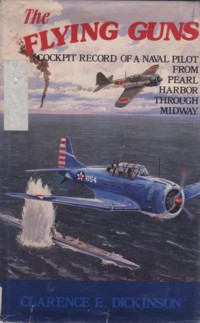
The Flying Guns, by Clarence E. Dickson


The Flying Guns: A Cockpit Record of a Naval Pilot from Pearl Harbor Through Midway, by Clarence E. Dickinson in collaboration with Boyden Sparkes. Phoito research by Thomas F. Mahar Jr.
Zenger Publishing Co, Inc. 1942
196 pages 17 pgs of b& w photos, no index

Description
This thrilling narrative is about the experiences of a Navy pilot who literally flew right into World War II in the Pacific at its very beginning.

Lieutenant Dickinson was with a squadron of planes which was on its way to Pear Harbor on the morning of December 7, 1941. As they approached the island of Oahu, they got caught up in a swarm of attacking Japanese planes. The author, flying a Dauntless dive bomber, was shot down, parachuted to safety, and after amazing difficulties, managed to reach Pearl Harbor while the Japanese attack was still going on.

His description of the fighting and the conditions at Pearl on that fateful day provide one of the few first-person narratives of the "day that will live in infamy."

But Pearl Harbor was only the first of the battles in which the author took part. A few days later, he became the first American to sink a Japanese submarine. Then, flying off the aircraft carrier Enterprise (the Big 'E'), he took part in some of the first American offensive moves in the war, namely the attacks on the Marshall Islands, Marcus Island and Wake Island, under the command of Admiral Halsey.

All of this action is described in great detail, with the authenticity one gets from a narrative by a person who actually participated in the strikes.

Then in June 1942, the author, much decorated by now, took part in one of the most important and decisive battles in history-the Battle of Midway. He not only took part , but actually helped sink the Japanese carrier Kaga by planting his bombs on her deck. Again, the author provides one of the few first-person accounts of this historic battle.

Because of the author's on-the-scene description of these critical military battles, this book is important. It provides an unparalleled picture of the war in the Pacific. But beyond this, there is no more exciting personal narrative of World War II in the annals of naval aviation literature.

Table of Contents
The chapters are not given separate titles.


______
This blog updated on Mondays and Fridays

Monday, December 6, 2010

The Battle of the Java Sea, by David Thomas


The Battle of the Java Sea, by David Thomas
Great Battles of the Modern World
Stein and Day, 1968
203 pages of text, plus a preface, four appendices (plus a Bibliography and Sources which is titled Appendix D), several photos, and an index.
Library: 940.4514 T455

Description
This is the first full account of what Winston Churchill called "the forlorn battle," the attempt by a desperately small fleet of British, Australian and Dutch ships to stem the Japanese advance into Southeast Asia in the days immediately following Pearl Harbor.

The battle was forlorn because the Allies were outnumbered, outclassed and outfought. Against a navy that was revealing itself as one of the best in the world, they had only a handful of cruisers and destroyers. The great capital ships that were intended to defend Singapore, Prince of Wales and Repulse, were among the first victims, sunk by aircraft in the Gulf of Siam, sacrificed by commanders who still believed the battleship could survive an air attack.

Mr. Thomas has reconstructed an hour by hour record of those grim days, days during which the Allied ships battled against confusion, muddle, misinformation, and plan bad luck, and one by one went to the bottom. His lucid analysis of these events is an important contribution to the history of the Second World War.

Table of Contents
1. Background to Aggression
2. Preparation for Infamy
3. The Mounting Peril
4. Allied Plans for the East
5. Despatch of the Deterrent
6. The Gulf of Siam
7. ABDA Command in Java
8. Battle off Balikpapan
9. The Tightening Vice
10. The Strike in Badung Strait
11. Overture to Battle
12. Battle of the Java Sea: Enemy in Sight
13. The First Hour of Battle
14. Destroyer Attacks
15. Loss of the Dutchmen
16. The Final Defeat

Appendices
A The Ten Point Note
B Japanese Naval Forces in the South West Pacific
C Reports of the Battle of the Java Sea
D Bibliography and Sources
E Principle Characteristics of Ships Engaged in the Battle

Photos:
The Japanese War Cabinet headed by Prime Minister Tojo. 1943.
Rear Admiral Shoji Nishimura
Rear Admiral Raizo Tanaka
Rear Admiral K.W.F.M. Doorman, Commander of the Allied Striking Force
Vice Admiral Sir Geoffrey Layton, Vice Admiral Conrad E.L. Helfrich, Rear Admiral William R. Purnell and Admiral Thomas C. Hart
Queen Helena of the Netherlands, Admiral Hart, Rear Admiral William A Glassford, Lieutenant-Commander H.P. Smith, Commander H.E. Eccles and Commander T.H. Binford
Rear Admiral Doorman and officers, Feb 26, 1942
Dutch destroyer Kortenaer
British destroyer Jupiter
US destroyer John D. Edwards
Japanese destroyer Amatsukaze
Allied flagship, Dutch cruiser De Ruyter
Dutch light cruiser Java
US heavy cruiser Houston
Australian light cruiser Perth
Britih heavy cruiser Exeter fighting off Japanese aircraft in the Banka Strait
Japanese light cruiser Jintsu
Japanese heavy cruiser Haguro
only known photo of cruiser Java in action in the Java Sea
USS Exeter sinking in the Java Sea
Captain H.M.L. Walker, commanding officer of the HMAS Perth

Maps - line drawings
Two-page map of South East Asia region
Singapore region
Battle of Balikpaan
Battle of the Java Sea track chart
Battle of the Java Sea final phase